

November 21, 2026

A practical guide to distinguishing responsibility from over-responsibility without losing your capacity to care.
What if some of the weight you’re carrying as a leader isn’t actually yours to carry?
Not the decisions you need to make.
Not the responsibilities that come with your role.
Not the commitments you’ve made to the people you serve.
I’m talking about another kind of weight.
The responsibility you feel for someone else’s disappointment.
The pressure to make sure everyone is happy.
The need to explain yourself until everyone understands.
The lingering concern that someone might be upset with you.
The unanswered question about why someone made a decision you didn’t anticipate.
Those burdens rarely appear on a job description.
Yet they can occupy an enormous amount of emotional and mental space.
And if you’re anything like me, you may have carried some of them for years without realizing how much they were affecting you.
I recently bumped into someone who used to be a member of our church.
They had left quietly, without explanation.
Not everyone who leaves hurts.
But this one did.
Seeing them again stirred up familiar questions.
Why did they leave?
Was it something I said?
Something I did?
Were they disappointed in me?
Did I miss something?
And before long, my mind was doing what it’s done so many times before.
Trying to answer questions I didn’t have the information to answer.
For much of my adult life, I’ve struggled with assuming responsibility for things that don’t actually belong to me.
Especially when it comes to other people.
As a pastor and leader, I care deeply about relationships.
I want people to feel valued.
I want to know when I’ve hurt someone.
I want to make things right when I’ve made a mistake.
Those are good desires.
But I’ve discovered that good desires can quietly become unhealthy burdens.
Caring about someone doesn’t mean I’m responsible for every decision they make.
That’s a distinction I’m still learning.
Years ago, I was much more likely to pursue people who had left, hoping to understand their reasons.
More recently, I’ve learned to give people the freedom to decide whether they want to have that conversation.
Some have.
Some haven’t.
And I’ve learned to respect both.
But here’s what I’ve also discovered.
I can stop pursuing an explanation and still be carrying the unanswered question.
The behavior can change before the emotional burden does.
And that’s why learning to release over-responsibility requires more than simply setting better boundaries.
It requires becoming aware of what we’re carrying and why.
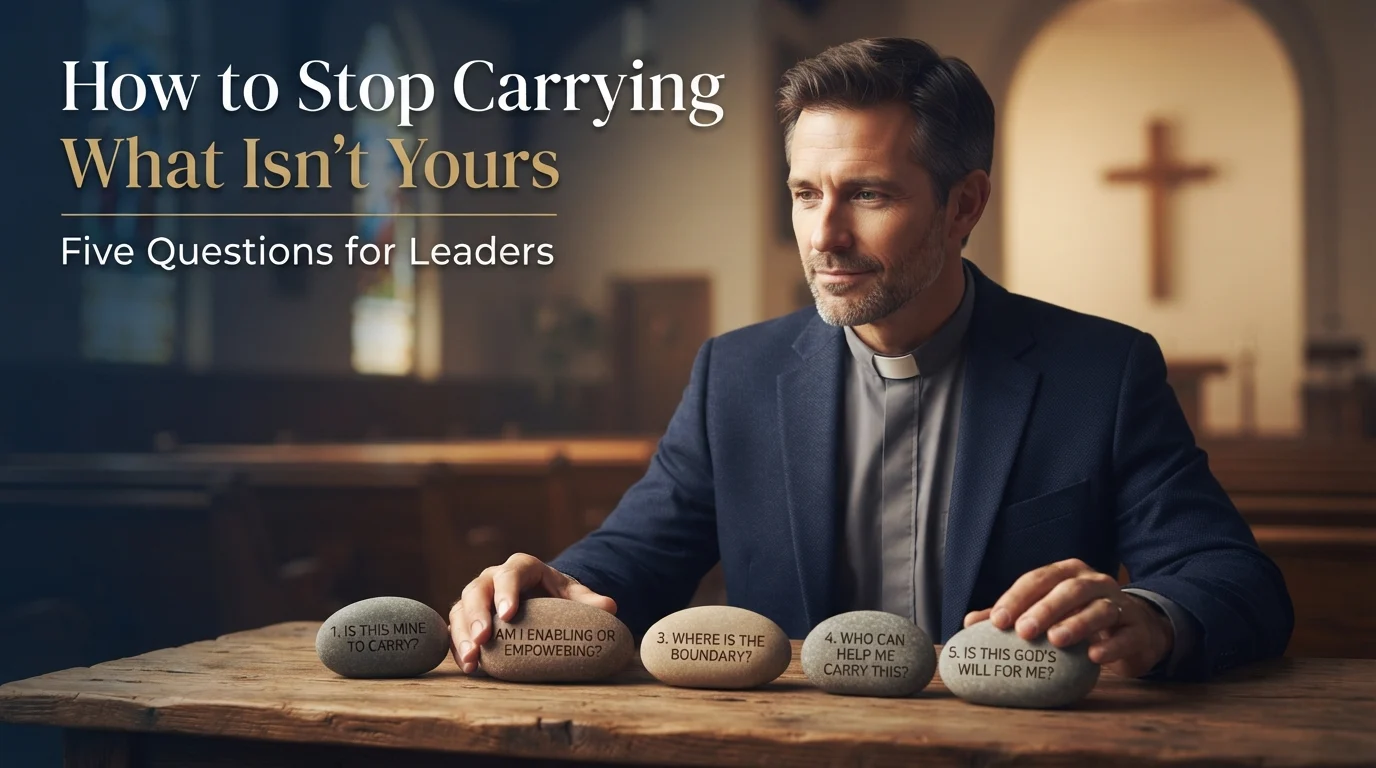
Here are five questions that are helping me.
This may be the most important place to begin.
Because when something happens that we don’t understand, our minds are remarkably good at filling in the blanks.
Someone doesn’t respond to an email.
We wonder whether they’re upset.
A team member seems unusually quiet.
We wonder whether they’re disappointed in our leadership.
Someone leaves an organization.
We wonder whether we did something wrong.
And before long, we’ve constructed an entire explanation.
But here’s the problem.
We may have very little actual information.
We’re working with assumptions.
Possibilities.
Imagined conversations.
And sometimes those imagined explanations become so familiar that we begin treating them as facts.
I’ve learned that the question “Why?” isn’t always helpful when I don’t have the information necessary to answer it.
It can become an invitation to endless speculation.
So I’ve been practicing a different question.
“What do I actually know?”
Not what I suspect.
Not what I fear.
Not what I imagine.
What do I know?
Perhaps I know that someone made a decision.
Perhaps I know they haven’t explained it.
Perhaps I know the decision disappointed me.
Those things may be true.
But that doesn’t mean I know their motives.
And it certainly doesn’t mean I’m responsible for their choice.
Not knowing why someone made a decision doesn’t mean you’re responsible for it.
Sometimes the most honest answer is simply, “I don’t know.”
And learning to live with that uncertainty can be an important step toward freedom.
This is where I want to be especially careful.
Because releasing over-responsibility is not the same as avoiding responsibility.
I don’t want to use healthy boundaries as an excuse to ignore the impact of my actions.
If I’ve hurt someone, I want to know.
If I’ve made a mistake, I want to acknowledge it.
If there’s something I need to learn, I want to remain teachable.
And if a difficult conversation is necessary, I want to have the courage to initiate it appropriately.
That’s responsibility.
But responsibility has limits.
I can be responsible for how I communicate without being responsible for whether everyone agrees.
I can be responsible for listening carefully without being responsible for whether someone is satisfied with the outcome.
I can apologize sincerely without being responsible for whether someone chooses to forgive me.
I can extend an invitation to talk without being responsible for whether someone accepts it.
And I can love people deeply without being responsible for every decision they make.
Here’s a question that helps me:
“What specific action, attitude, or responsibility genuinely belongs to me in this situation?”
Notice the word specific.
Over-responsibility tends to be vague.
“I should have done more.”
“I should have known.”
“I should have prevented this.”
But genuine responsibility can usually be named more clearly.
“I need to apologize for what I said.”
“I need to follow through on a commitment.”
“I need to listen before making a judgment.”
“I need to clarify an expectation.”
When we identify what’s actually ours, we can take meaningful action.
And when we’ve done what is ours to do, we can begin releasing the rest.
This question can be uncomfortable.
Because our desire to help often comes from a good place.
We want people to succeed.
We want relationships to be healthy.
We want problems resolved.
We want others to experience peace.
But sometimes our desire to help becomes a desire to control.
We keep explaining because we need someone to understand.
We keep pursuing a conversation because we need closure.
We keep offering advice because we need someone to make what we believe is the right decision.
We keep intervening because we’re uncomfortable watching someone struggle.
And we may not recognize how much of our own emotional security has become attached to the outcome.
I’ve been appreciating yet again Mel Robbins’ Let Them Theory.
The basic distinction is simple.
Let them.
Let people make their decisions.
Let them think what they think.
Let them feel what they feel.
Let them decide whether they want to explain.
And then:
Let me.
Let me decide how I will respond.
Let me examine my own heart.
Let me take responsibility for my actions.
Let me remain available without insisting.
Let me love people without trying to manage their lives.
It’s simple language.
But I don’t find it easy.
Because sometimes I want to help someone partly because I care about them and partly because I need the situation to turn out a certain way.
That’s worth noticing.
So here’s the question:
“Am I taking this action because it genuinely serves the other person, or because I need a particular outcome in order to feel okay?”
The answer may be a little of both.
And recognizing that doesn’t mean we’re bad leaders.
It simply gives us an opportunity to grow.
This question gets beneath the surface.
Because sometimes we have done what we needed to do.
We’ve communicated.
We’ve listened.
We’ve apologized.
We’ve extended an invitation.
We’ve made the decision.
We’ve respected the other person’s freedom.
And yet the situation continues to occupy our thoughts.
We replay conversations.
Imagine alternative outcomes.
Wonder whether we could have done something differently.
Rehearse explanations we may never have an opportunity to give.
The external responsibility may be complete.
But internally, we’re still carrying it.
I’ve experienced that.
And I suspect many leaders have.
Here’s what I’m learning:
A behavioral boundary doesn’t automatically create emotional freedom.
I can decide not to chase someone down for an explanation.
But I may still need to practice releasing my desire to know.
I can respect someone’s decision.
But I may still need to acknowledge the disappointment I feel.
I can recognize that someone else’s opinion isn’t mine to control.
But I may still find myself wanting to change it.
That’s part of the ongoing work of self-leadership.
And sometimes the most helpful thing we can do is simply name what’s happening.
“I’m still disappointed.”
“I wish I understood.”
“I’m afraid this person thinks poorly of me.”
“I feel responsible, even though I know this isn’t entirely mine.”
Naming those feelings doesn’t mean they’re accurate assessments of our responsibility.
It means we’re being honest about our experience.
And honesty creates room for discernment.
Here’s the question:
“What am I continuing to carry internally even though I’ve already done what was mine to do?”
That may reveal a burden that needs to be acknowledged before it can be released.
This is where the conversation becomes especially meaningful for me.
Because I don’t want to become indifferent.
I don’t want to stop caring about people.
I don’t want to withdraw from relationships simply because they’re complicated.
And I certainly don’t want to use the language of boundaries to excuse selfishness or avoidance.
I want to remain faithful.
But I’m learning that faithfulness and control are not the same thing.
There’s a verse in Romans that has been helpful to me:
“If possible, so far as it depends on you, live peaceably with all.” — Romans 12:18
I love those words.
So far as it depends on you.
They call me to take responsibility.
For my words.
My actions.
My attitudes.
My willingness to pursue peace.
But they also acknowledge something important.
Not everything depends on me.
I can pursue peace without being able to guarantee it.
I can offer love without controlling how it’s received.
I can invite reconciliation without requiring another person to participate.
I can remain faithful without determining the outcome.
And that leads me to a question I want to keep asking:
“If I released my need to control the outcome, what would faithfulness require of me now?”
Maybe it would mean having a conversation.
Maybe it would mean apologizing.
Maybe it would mean extending an invitation.
Maybe it would mean giving someone space.
Maybe it would mean praying for someone and entrusting them to God’s care.
And sometimes?
Maybe it would mean doing nothing more.
Not because I don’t care.
But because I’ve already done what belongs to me.
A Simple Practice: Own It, Offer It, Release It
As I’ve reflected on these questions, I’ve begun seeing a simple practice that may help.
Own it.
Identify what genuinely belongs to you.
Your actions. Your attitudes. Your commitments. Your responsibilities.
Take responsibility for those things.
Offer it.
Offer what is appropriate.
An apology.
A conversation.
Encouragement.
Support.
An invitation.
An opportunity for reconciliation.
But remember that an offer is not a demand.
The other person retains the freedom to respond.
Release it.
Release what doesn’t belong to you.
Their decisions.
Their reactions.
Their opinions.
Their willingness to engage.
Their response to what you’ve offered.
This doesn’t mean the emotional weight will disappear immediately.
Sometimes you’ll need to practice releasing the same burden again tomorrow.
And perhaps the day after that.
I’m discovering that growth often looks like that.
Not a single dramatic breakthrough.
But a series of small, faithful decisions.
The Freedom to Love Without Carrying Everything
One of my greatest hopes is that I will continue growing in my ability to love people well.
Not less.
More.
More genuinely.
More freely.
More generously.
Without needing to control their responses.
Without assuming responsibility for every disappointment.
Without allowing unanswered questions to occupy so much space in my mind.
Because I’ve come to believe that over-responsibility doesn’t necessarily make us more loving.
Sometimes it makes us more anxious.
More defensive.
More controlling.
And less able to be fully present.
But when we begin distinguishing what belongs to us from what belongs to others, something changes.
We become freer to listen without needing to fix.
To care without needing to control.
To serve without needing to be appreciated.
To love without requiring a particular response.
Letting go of control is not the same as letting go of care.
In fact, it may be one of the ways we learn to care more faithfully.
Is there a relationship or situation that’s occupying more emotional space than you’d like?
Perhaps someone is disappointed with you.
Perhaps a decision didn’t go the way you hoped.
Perhaps a conversation remains unresolved.
Perhaps you’re carrying a question you may never have answered.
Before trying to fix anything, consider these five questions:
You may discover there’s something you need to do.
If so, do it.
But you may also discover that the next faithful step isn’t another conversation to pursue or another problem to solve.
Sometimes the next faithful step is a burden to put down.
And perhaps you need to put it down more than once.
That’s okay.
I’m still learning, too.
Leadership involves real responsibility.
But it also involves emotional weight that can be difficult to sort through on our own.
Sometimes we need a safe place to examine what we’re carrying, recognize what’s genuinely ours, and discover what we can release.
That’s why I created The Executive Counsel.
It’s a confidential space for leaders to think out loud, navigate complex relationships and decisions, and find clarity about their next faithful step.
If you’re carrying more than you know what to do with, I’d welcome a conversation.
Because leadership carries weight.
But you don’t have to carry it alone.
Know weight. No isolation.
Leadership carries weight. But not every burden you’re carrying belongs to you.
Sometimes the hardest part of leadership isn’t making another decision. It’s finding enough clarity to distinguish what’s genuinely yours to own from what you’ve quietly assumed.
Through The Executive Counsel, I offer leaders a confidential space to think out loud, examine the pressures they’re carrying, and discover their next faithful step.
If you’re navigating difficult relationships, complex decisions, or the emotional weight of leadership, I’d welcome a conversation.
You don’t have to figure it all out alone.
Know weight. No isolation.
Jeff Meyer
Executive Coach | Organizational Clarity Consultant