

October 29, 2026
I’ve met leaders with decades of experience who seem to grow wiser with every passing year.
I’ve also met leaders with decades of experience who appear to keep encountering the same problems.
The same frustrations.
The same relational tensions.
The same patterns of decision-making.
The same disappointing outcomes.
What’s the difference?
It isn’t necessarily intelligence.
It isn’t always training.
And it certainly isn’t the number of years they’ve been leading.
I wonder whether part of the difference is what they do with their experiences.
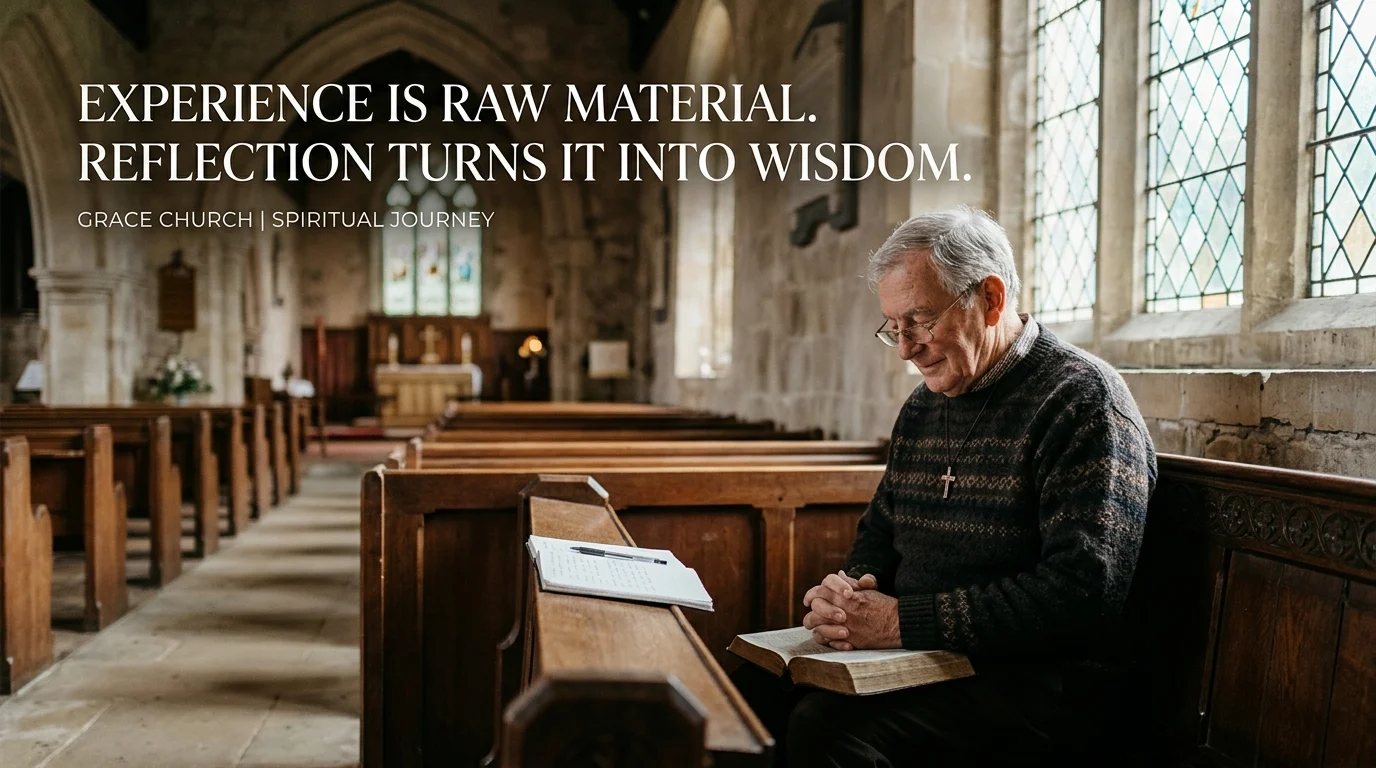
Because there’s something I’ve come to believe:
And if we’re not careful, we can spend our entire lives accumulating experiences without ever fully receiving what they have to offer.
Think about the last important meeting you attended.
Maybe you were leading it.
Maybe you were participating in a difficult conversation.
Perhaps there was tension in the room. Someone challenged an idea. A decision was made. Something unexpected happened.
And then the meeting ended.
What happened next?
If you’re like most leaders, you probably moved immediately to the next responsibility.
Another meeting.
Another email.
Another problem to solve.
Another person needing your attention.
And the experience you just had?
It became one more event on an already crowded calendar.
But what if there was something in that meeting worth noticing?
Perhaps someone who rarely speaks finally contributed an important insight.
Perhaps you became unusually defensive when a particular issue surfaced.
Perhaps the group reached a breakthrough when someone asked a question nobody had considered.
Perhaps you left the room energized.
Or strangely discouraged.
Those responses are worth examining.
They may tell you something about your leadership, your team, or the assumptions shaping your decisions.
But if you never stop to notice them, the opportunity to learn may quietly slip away.
Some of my most meaningful personal discoveries have come through intentional reflection.
Over the years, I’ve practiced different rhythms.
At times, I’ve scheduled quarterly overnight retreats to step away from the demands of everyday life.
I’ve practiced Morning Pages, an approach introduced by Julia Cameron in The Artist’s Way.
I’ve also been influenced by Curt Thompson’s Anatomy of the Soul, which has helped shape the way I think about our inner lives, relationships, and spiritual formation.
I haven’t maintained those practices perfectly.
There have been seasons when I’ve been consistent and seasons when I’ve drifted away from them.
But when I return to intentional reflection, something remarkable often happens.
I begin writing about something I think I understand.
A difficult conversation.
A frustration.
A disappointment.
An unexpected success.
And as I continue, I discover something beneath the experience that I hadn’t previously recognized.
Sometimes it’s an assumption.
Sometimes it’s a fear.
Sometimes it’s a desire I’ve been neglecting.
And sometimes it’s a reminder of who I am in God’s eyes.
I’ve described this experience as peeling back layers of wallpaper over my soul.
And that’s what it can feel like.
Layer after layer of expectations, reactions, experiences, and assumptions gradually becomes visible.
Not because I’m trying to manufacture an insight.
But because I’ve finally made room to notice.
Now, there’s an important distinction here.
Because not all thinking about the past is helpful.
Some of us spend plenty of time replaying experiences.
We revisit a difficult conversation.
We imagine what we should have said.
We question our decisions.
We rehearse someone else’s criticism.
We wonder how things might have turned out differently.
And we can spend hours doing it.
But that’s not necessarily reflection.
Sometimes it’s rumination.
And while reflection can lead toward understanding and growth, rumination often leaves us circling the same unresolved thoughts.
Here’s how I distinguish them.
Rumination asks, “Why did that happen to me?”
Reflection asks, “What can I learn from what happened?”
Rumination says, “I can’t believe I handled that so poorly.”
Reflection asks, “What was happening within me that influenced my response?”
Rumination keeps returning to the problem.
Reflection begins looking for understanding and a faithful way forward.
Of course, real life isn’t always that tidy. Some painful experiences need more than a few minutes of journaling. And sometimes we need the help of a trusted friend, counselor, or coach to process what we’ve experienced.
But the distinction is still helpful.
And sometimes the most important thing we can learn is that we need to stop analyzing and allow ourselves to rest.
One of the things I’ve come to appreciate is that our lives are constantly giving us information.
Our emotions.
Our energy.
Our recurring frustrations.
Our moments of joy.
Our relational patterns.
Even the situations we find ourselves avoiding.
They can all become opportunities for greater awareness.
Consider a leader who repeatedly leaves team meetings frustrated.
The easy conclusion might be that the team is the problem.
They’re unprepared.
They don’t take initiative.
They aren’t thinking strategically.
And perhaps some of those concerns are legitimate.
But reflection might uncover something else.
Maybe the leader is asking questions that don’t invite participation.
Maybe decisions are being revisited because expectations haven’t been clarified.
Maybe the leader is frustrated because the team isn’t meeting a standard that has never been communicated.
Or perhaps the frustration reveals a deeper concern about control, trust, or the fear of failure.
Without reflection, the leader may simply keep experiencing the same frustration.
With reflection, the experience becomes an opportunity for discovery.
That’s why I believe our emotional responses deserve attention.
Not because every feeling tells us the truth.
But because every feeling may tell us something worth understanding.
The question is whether we’ll pay attention long enough to learn from them.
I don’t think reflection needs to become another complicated leadership system.
In fact, the more elaborate we make it, the less likely we may be to practice it.
I’d suggest beginning with three simple movements.
Notice: What happened?
Start with the experience itself.
Not your interpretation.
Not your judgment.
Just what happened.
What stood out?
What surprised you?
What affected you more than you expected?
What gave you energy?
What drained it?
Sometimes this is where journaling becomes especially helpful.
Writing forces us to slow down enough to put language around something we’ve experienced.
And I’ve often discovered that I don’t fully understand what I’m thinking until I begin writing it down.
This is where reflection begins to deepen.
Why did that experience affect me?
What assumptions was I making?
What expectations were operating?
What was I afraid of?
What did I value in that moment?
What might I be missing?
This step requires curiosity rather than condemnation.
We’re not trying to prosecute ourselves.
We’re trying to understand ourselves.
And sometimes the most important insight isn’t about the situation at all.
It’s about the person we brought into it.
Reflection isn’t complete simply because we’ve discovered something interesting.
The question becomes:
What will I do with what I’ve learned?
Perhaps there’s a conversation to initiate.
An assumption to challenge.
An apology to offer.
A priority to protect.
A responsibility to release.
Or a practice worth repeating.
Sometimes the next step is simply to keep paying attention.
And sometimes it’s to wait.
Not every insight demands immediate action.
But when reflection leads us toward a more faithful response, experience begins to become wisdom.
Notice. Explore. Respond.
Three simple movements.
Not a formula that guarantees insight.
Just a rhythm that creates room for it.
What About the Time?
I can almost hear the objection.
“This sounds wonderful, Jeff. But when am I supposed to do it?”
I understand.
Life is full.
Leadership is demanding.
And adding another practice can feel like adding another burden.
But here’s what I’d encourage you to consider.
Reflection doesn’t always require a large block of time.
Sometimes five minutes after a meeting can make a difference.
Before you open the next email, ask yourself:
What just happened?
What did I notice?
What might I learn from it?
Sometimes ten minutes with a journal at the beginning or end of the day can reveal a pattern that has been developing for weeks.
Sometimes an hour each week creates enough distance to see what the daily pace has obscured.
And occasionally, an extended retreat provides room for deeper reflection.
I’ve benefited from all of those approaches.
The important thing isn’t the length of time.
It’s the willingness to pay attention.
And if you miss a day, a week, or even a season?
Begin again.
Reflection is an invitation, not another standard by which to judge yourself.
There’s another reason this matters deeply to me.
As a follower of Jesus, I don’t believe reflection is simply about becoming more self-aware.
It’s also about becoming more receptive to the work God is doing within me.
Psalm 139 begins with an extraordinary declaration:
“O LORD, you have searched me and known me!”
And near the end, David prays:
“Search me, O God, and know my heart!”
I’ve always found that combination fascinating.
God already knows David.
Yet David invites God to search him.
I think there’s something important here.
God doesn’t need us to reflect so He can discover who we are.
But perhaps we need reflection to become more willing to see what He already knows.
Our fears.
Our desires.
Our wounds.
Our gifts.
Our resistance.
Our longing to be loved.
And the ways He is patiently forming us into the likeness of Jesus.
This isn’t always comfortable work.
But it can be profoundly freeing.
Because we’re not examining ourselves in order to earn God’s acceptance.
We’re learning to become honest in the presence of the One who already knows us and loves us.
And that’s a very different starting point.
I wonder how many important lessons we’ve rushed past because we were too busy moving on to the next thing.
How many patterns have repeated because we never stopped to recognize them?
How many moments of grace have gone unnoticed?
How many invitations to grow have been buried beneath another full calendar?
We can’t recover every missed opportunity.
And we don’t need to analyze every moment of our lives.
But we can begin paying attention to the life we’re living now.
The conversations we’re having.
The decisions we’re making.
The emotions we’re experiencing.
The people we’re becoming.
Because all of it offers something worth noticing.
And sometimes the greatest insights don’t come from extraordinary experiences.
They come from ordinary experiences we’ve finally taken the time to understand.
Before this week ends, I’d encourage you to find ten quiet minutes.
Take a notebook.
Find a place where you won’t be interrupted.
And consider these three questions:
What happened this week that affected me more deeply than I expected?
What might that experience be revealing about me?
What is one faithful response I can make to what I’m discovering?
Don’t force an answer.
Don’t turn it into another performance review.
Simply make room to notice.
You might discover something about your leadership.
You might recognize a pattern in your relationships.
You might find clarity about a decision you’ve been carrying.
Or perhaps you’ll simply become more aware of God’s presence in the ordinary experiences of your life.
Whatever emerges, pay attention.
Because the experiences of your life are too valuable to simply rush past.
And sometimes the most important thing we can do isn’t to move on to the next experience.
It’s to receive what this one has to teach us.
Walking with you toward clarity,
Jeff Meyer
Executive Coach | Organizational Clarity Consultant | Auxano Lead Navigator
Sometimes the most valuable part of reflection is having someone who will listen, ask thoughtful questions, and help you recognize what you haven’t yet been able to see.
That’s part of the work I love doing through The Executive Counsel.
If you’re navigating a complicated decision, noticing recurring patterns, or simply needing a confidential place to process what’s happening in your leadership and life, I’d welcome a conversation.
Let’s make room for clarity together.
You Don’t Have to Find Clarity Alone
Sometimes the most important discoveries happen when we finally have room to think out loud.
Through The Executive Counsel, I offer leaders a confidential place to reflect, recognize patterns, challenge assumptions, and discover what matters most.
Not another meeting filled with expectations. A place where you can be honest, be heard, and gain clarity about your next faithful step.
Ready to make room for clarity? Let’s have a conversation.